Impact modifiers are added to plastic blends to improve the durability and toughness of various plastic resins. Depending on the end application and the internal resistance of the polymer, formulators must achieve very different levels of impact resistance, from general purpose to ultra-durable.
What are impact modifiers for?
General purpose impact modification
General purpose impact modification is a very low level of impact modification that is used, for example, to avoid conditioning of molded polyamide parts.
- This means acceptable impact toughness at room temperature, but does not take into account any requirement for low temperature (below 0°C) impact toughness.
- Most applications of this type require only low levels of impact modifier (<10%), and the impact modifier need not contain reactive groups to be acceptable for the application.
Low temperature impact modification
Low-temperature impact toughness is essential for applications that require a certain level of low-temperature flexibility and fracture resistance. This is, for example, the case for many applications in the field of household appliances. This requires modifiers containing 5-15% predominantly reactive modifiers.
Ultra-high strength
Ultra-high impact toughness is required for applications that should not result in part failure even when impacted at low temperatures (-30 to -40°C) at high speed. This requirement can only be met with a high content (20-25%) of a reactive impact modifier with low Tg.
In addition to impact toughness, impact modifiers can also help improve other material characteristics such as:
- Optical and tensile properties
- Weather resistance
- Processability
- Flammability
- Heat distortion
How do impact modifiers work?
The elastomeric and rubbery nature of impact modifiers absorbs or dissipates impact energy. Impact modifiers can be incorporated by polymerization in a reactor or can also be incorporated as additives during the compounding step. Two mechanisms by which impact modifiers work are discussed below.
Craze Propagation
The principle is to disperse impact modifiers in a brittle matrix, a damping phase capable of absorbing energy and stopping crack propagation.
Shear Band/Cavitation
The second mechanism is the formation of shear bands around the elastomeric particle, which absorb the deformation energy. This mechanism is always accompanied by cavitation of the damping particle (appearance of voids), which also absorbs energy. However, the appearance of shear bands absorbs most of the energy.
To be effective, the dispersed phase must have the following properties:
- Dampening capability: The elastomeric phase is recommended. Generally, low glass transition materials and low crystallinity polymers are used. Low Tg is absolutely required for low-temperature toughening. Polyolefin copolymers are excellent candidates.
- Good cohesion with the continuous phase: this parameter is key for effective hardening. Lack of cohesion can initiate multiple cracks which can then propagate to fracture. Good cohesion can be achieved by specific interactions at the surface or by reactivity. Combination occurs through the formation of "amphiphilic" copolymers at the interface, reducing surface tension and increasing adhesion.
Polymer compatibility also affects the size, regularity and stability of the dispersion, which positively affects the mechanical performance of the finished part.
Functionalized polyolefin impact modifiers
In order to fulfill the industry requirements, polymers, such as polyamide, polyester, PVC or bioplastics, need improved impact resistance.
Among the impact modification technologies available on the market, polymer impact modifiers, also known as functionalized polyolefins, offer a full range of strengthening characteristics from general purpose to super-hardening in a variety of polymer systems.
Polyamides (PA)
A wide range of impact modifiers based on functionalized or non-functionalized copolymers or ethylene ionomers can meet the unique needs of your PA 6, PA 6,6 or fiberglass reinforced PA compounds.
Industry-leading impact resistance:
- Super-tough impact resistance
- Low-temperature toughness
- Intermediate toughness at reduced cost
Additional benefits:
- Improved flow for better performance
- Aesthetic properties (class A, excellent surface finish, excellent coloration)
- FDA compliance for direct contact with food products
Polyesters (PBT, PET)
Polymer impact modifiers for engineering polymers or cast sheets offer a wide range of performance levels, allowing you to create customized solutions that meet your unique needs.
- Engineering polymers: For the most demanding applications, some polymer impact modifiers provide ultra-high impact toughness in virgin and glass fiber reinforced compounds. However, when compounding PBT engineering polymers, the challenge is to improve impact toughness while maintaining the original properties.
Among a wide range of offerings, these impact modification solutions provide compounders with a valuable new tool for tailoring the properties of PBT resins to meet the requirements of electrical and electronic connectors, as well as a wide range of other industrial and consumer products.
- Cast sheet applications: Improving performance while achieving the required impact toughness properties is a very challenging task when it comes to PETF-based cast sheet applications.
| Advantages in the application of engineering polymers | Advantages in the application of cast sheet |
- Strengthening and preservation of original properties
- Higher melt flow
- Improved processability
- Better thermo-stability
- Higher-strength retention (tensile strength and flexural modulus)
- Enhanced hydrolysis resistance
|
- Improved productivity (cycle time, process stability, regrind utilization)
- Material cost reduction (lower viscosity PET) (CPET)
- Food regulations compliant (FDA, European) (APET)
|
|---|
Polyvinyl chloride (PVC)
Depending on the end use, different types of PVC resins need different impact modification additives to achieve the desired performance characteristics.
| Flexible PVC | Rigid PVC |
- Durable strength and flexibility
- Best low-temperature properties
- Better retention of properties after heat aging
- Better flexibility after chemical exposure
|
- Improved flow and melting characteristics of the compound
- Improved compatibility with fillers
- Below the processing temperature
- Higher throughput
- Higher filler loading
- Lower stabilizer content
|
|---|
Polypropylene (PP)
Polypropylene is a semi-crystalline polymer that has a very attractive price/performance ratio and is easy to process. However, to meet some industrial needs, polypropylene requires increased impact resistance at ambient or low temperatures.
Impact modifiers improve the strength of polypropylene at room or low temperatures. The wide range of products allows us to offer a unique and customized solution for each situation.
Additional benefits:
- Improved dispersion of pigments, glass fibers or mineral fillers
- Improved compatibility for polypropylene alloys
Acrylonitrile butadiene styrene (ABS)
ABS resins are on a level between engineering plastics such as polycarbonate and commodity materials such as polystyrene. They are widely used in applications such as computer and printer housings, consumer electronics, appliances, gardening equipment, automotive parts and toys.
While producing ABS compounds, whether standard, recycled or filled, poor toughness can be encountered.
Impact modification is a very complex problem for which there is one specific solution depending on the temperature required to achieve the overall strength characteristics.
Additional benefits:
- High compatibility
- High dispersibility (allows for changes during processing)
Polycarbonate compounds (PC/ABS, PC/PBT)
Modern requirements for polycarbonates are related to high impact toughness at low temperatures while maintaining good processability, which makes it possible to efficiently produce highly specific parts and profiles, e.g. for the automotive industry, by injection molding.
Depending on the polymer used to mix the PC-based resin and the desired viscosity level, a specific additive is required.
Compared to alternative technologies, additional advantages can be found in the following:
- Better compound recyclability due to lower melt viscosity
- Better UV resistance and heat resistance
- Higher elongation
- Easier transportation and recycling due to granule form rather than powder form
Core-shell impact modifiers
These materials typically have a low-TG rubber core, such as butyl acrylate or butadiene, with a sheath of poly (methyl methacrylate) PMMA.
One of the main advantages of the core-shell impact modifier method is that a predetermined particle size is provided. However, for the impact modifier to be effective for strengthening engineering plastics, it must be properly dispersed in and bonded to the matrix polymer.
This bonding can be the result of physical interaction of the sheath matrix with the matrix or a chemical reaction. The most obvious way to do this is to combine reactive fragments in the sheath chain during fabrication by emulsion polymerization. These reactive fragments subsequently react with the matrix during melt processing.
MBS impact modifiers compared to acrylic impact modifiers
| Butadiene-styrene methacrylate (MBS) | Acrylic exposure modifiers |
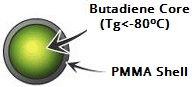 | 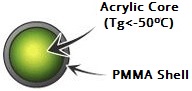 |
Advantages:
- Excellent low temperature resistance
- Excellent coloration
- Excellent dispersibility in most engineering plastics matrices
|
Advantages:
- Excellent low temperature resistance
- Excellent resistance to ultraviolet radiation
- Excellent heat resistance
- Good coloration
|
|---|
Application:
- External (painted), internal
|
Application:
- External (ultraviolet and thermal), internal (point heat sources)
|
|---|
- MBS core-shell impact modifiers are designed to provide exceptional low temperature impact in a wide range of engineering plastics such as polycarbonate, polycarbonate alloys (PC/ABS, PC/PBT) and polyesters.
- The core-shell impact modifier gives polycarbonate better low-temperature impact strength, color castability and thermal stability than any other acrylic available on the market.
MBS impact modifiers in polycarbonate
Polycarbonate (PC) is known for its transparency, superior impact resistance and ability to withstand high temperatures throughout the life of the final product.
However, the low chemical resistance of PC (to gasoline) is a problem for automotive applications. Another limitation is the injection molding of highly viscous grades, especially when high impact resistance is required.
In addition, the inherent characteristics of PC, such as impact resistance, are also seriously degraded when colored pigments, fillers, or flame retardants are used in the mix.
Recycled PC is a cost-effective solution for compounders. However, the recycling steps reduce the mechanical characteristics of PC, making it necessary to use impact modifiers in recycled PC to achieve the desired performance level.
Benefits of MBS impact modifiers in polycarbonate:
| Advantages | Description |
| Exceptional low-temperature impact characteristics |
- MBS modifiers allow PCs and especially high-performance PCs to achieve high impact characteristics at very low temperatures.
- High performance butadiene rubber based impact modifiers (ABS or MBS) adversely affect the inherent UV and heat resistance of polycarbonate.
- In outdoor or high temperature applications, it is critical to use a very stable impact modifier that will still provide high impact performance. Impact modifiers are designed to solve this technical problem.
|
|---|
| Excellent resistance to weathering and heat aging |
- MBS modifiers provide the excellent weathering resistance expected from a fully acrylic modifier.
- This allows impact modifiers to be used in applications that require good color retention and mechanical properties under typical external exposure, yielding products that maintain long-term performance under harsh conditions.
|
|---|
| Exceptional dyeing ability in injection molding applications |
- MBS modifiers provide much better color than most acrylic modifiers available on the market, which are known to reduce color intensity, making it difficult, if not impossible, to obtain darker details.
- Based on patented technology, they have opened the door to applications that require good color retention and unique mechanical properties when exposed to the environment.
|
|---|
MBS impact modifiers in polycarbonate compounds (PC/ABS, PC/PBT) (PC/ABS, PC/PBT)
To meet new market demands, including technical performance but also cost, compounders have developed polymer blends that balance the superior benefits of polycarbonate with the unique value for money characteristics of other matrices such as ABS or polyesters (PBT).
These polymer blends provide high performance compared to traditional PC. These blends help:
- Overcoming poor flow and brittleness characteristics - A rubber phase, such as acrylonitrile-butadiene-styrene (ABS), can be added to the PC matrix to improve the flow characteristics in opaque applications of high-strength PC.
PC/ABS is today's fastest growing PC grade where ABS allows a balance of high impact toughness, surface finish and high flowability for better processing. The disadvantage is that PC/ABS mixtures often do not meet the new flame retardancy standards.
The most common end users of PC/ABS are automotive parts, office equipment enclosures, computers and cell phones.
- Overcoming low chemical resistance - Polycarbonate is known to have very low chemical resistance, which is a critical characteristic in the automotive industry when in contact with oil and gasoline.
To overcome this weakness, polycarbonate and polyesters such as PBT are blended to produce an alloy with high chemical resistance, which unfortunately results in poor impact performance of PBT.
But when it comes to processing, adding fillers, color pigments or flame retardants, all of these mixtures lose their original critical strength values.
Benefits of MBS impact modifiers in polycarbonate compounds:
| Advantages | Description |
| Better compatibility |
The high impact toughness of PC/ABS alloys will largely depend on the ability to well disperse the various polymer phases (PC, PB, SAN), which is usually achieved with technical compounds. |
|---|
| Excellent low-temperature effect |
Their low glass transition temperature (Tg<-80°C) on impact allows them to be used for demanding low temperature applications to create products that can withstand temperatures as low as -50°C and maintain their structural integrity. |
|---|
| Good dispersibility |
Impact modifiers are easily dispersed using conventional compounding methods. The resulting engineering plastics blends are easily poured into molding equipment and have exceptional impact toughness resistance. |
|---|
MBS impact modifiers in polyesters
Polyesters such as polybutylene terephthalate (PBT) and polyethylene terephthalate (PET) are semi-crystalline polymers showing very attractive characteristics such as high temperature resistance and chemical resistance. On the other hand, polyesters show low resistance to low temperature impact, so impact modifiers are needed.
Polyesters are often used in automotive applications, such as power window actuator housings and light-conducting housings. They are also used for many household appliances, electrical engineering and medicine.
Advantages of MBS impact modifiers in polyesters:
| Advantages | Description |
| Excellent low-temperature effect |
The low glass transition temperature (Tg<-80°C) of impact modifiers allows them to be used for demanding low-temperature applications to create products that can withstand temperatures as low as -50°C while remaining ductile. |
|---|
| Good dispersibility |
Impact modifiers are easily dispersed using conventional compounding methods. The resulting engineering plastics blends are easily poured into molding equipment and have exceptional impact toughness resistance. |
|---|
Thermoplastic elastomers (TPE) as impact modifiers
A thermoplastic elastomer is generally defined as a polymer that can be processed as a thermoplastic material, but also has the properties of a conventional thermosetting rubber.
Some of the common classes of commercial TPEs include:
- Styrene block copolymers
- Thermoplastic polyurethanes
- Thermoplastic copolymers
- Thermoplastic polyamides
To be classified as a thermoplastic elastomer, the material must have the characteristics listed below.
- Ability to stretch to moderate elongations and return to a shape close to the original shape after stress is released
- Recyclability as a melt at elevated temperatures
- No significant creep
TPE – Advantages and disadvantages:
| Advantages | Disadvantages |
- Recyclable. Have the typical elastic properties of rubbers that are not recyclable.
- Require little or no compounding, with no need to add reinforcing agents, stabilizers or curing systems.
- Consume less energy.
|
- Melt at elevated temperatures and this may limit their use with certain engineering plastics.
- May require drying before processing.
- There are a limited number of low-modulus materials that can be used in TPEs.
|
|---|
TPEs are often used when conventional elastomeric materials cannot provide the range of physical properties required for a product. Thus, their use depends on the end use, and specific TPEs are used depending on the end need.
This is another example of the requirement to achieve an appropriate balance of elastic modulus and impact properties during impact modification of engineering plastics. This feature is relevant and important for all described approaches.
Bulk elastomeric compounds as impact modifiers
The approach to using bulk elastomeric compounds as impact modifiers differs from the use of core-shell type materials, as the size of the dispersed rubber phase depends on the processing conditions used. This allows the particle size in the final impact modified product to be controlled.
Disadvantages of using elastomers as impact modifiers
One of the biggest drawbacks of this approach is that the stiffness reduction seen with the addition of elastomer is typically greater than with core-shell type modifiers. This means that if maintaining the stiffness that the engineering plastic provides is critical to the application, the elastomer concentration must be adjusted accordingly. An example is the modification of PBT using an elastomeric blend.
In this case, the processing conditions of the PBT/elastomer blends affect the particle size of the elastomer and thus the impact modification achieved. In addition, the relative viscosity of the components affects the morphology of the final blend. Since melt viscosity is directly related to the molecular weight of the polymers, it follows that molecular weight is an important factor in determining the observed impact modifications.
Based on SpecialChem
■